Video Poker Strategy: The Optimal-Play Chart for Every Pay Table

Video poker strategy means following a hold-by-hold chart built for one specific pay table, not trusting a hunch about which cards to keep. Every video poker machine draws from a fixed, fully enumerable 52-card deck, so once the pay table is known the exact return to player can be calculated in advance, something no slot machine allows. Playing the correct chart for that pay table minimizes the house edge on nearly every version of the game, and on a handful of full-pay variants, perfect play tips the math onto the player's side instead. None of that guarantees a winning session. It guarantees the mathematically correct decision on every hand dealt. For the basic rules of five-card draw video poker before diving into the math, see Everything You Need to Know About Video Poker or The Ultimate Video Poker Showdown; this guide assumes those rules and goes straight to the holds.
Why Video Poker Strategy Is Pure Math, Not a Hunch
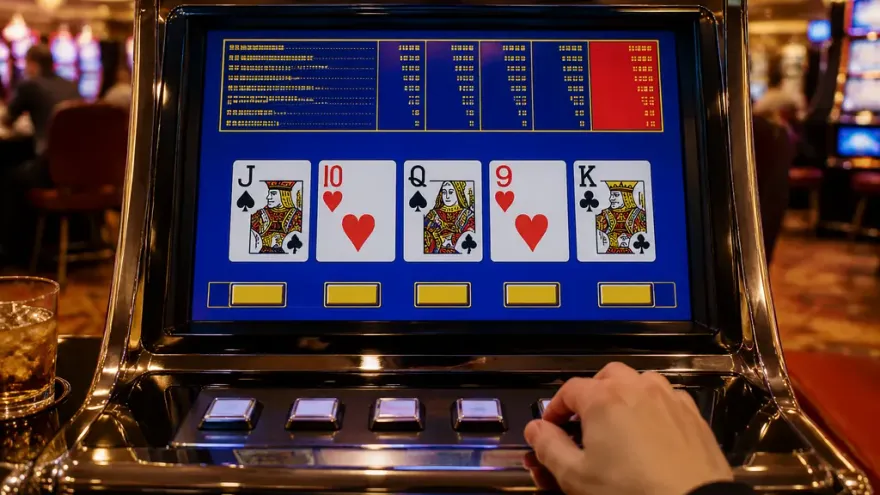
A slot machine's return is set by a weighting table the manufacturer never publishes in full. Video poker works differently. The math is open: 52 cards, a published pay table, and a deck that can be fully enumerated hand by hand. That openness is what makes a strategy chart possible at all.
- Expected value
- The average return a hold produces across every possible draw it could result in, calculated once by computer and used to rank every hold on a strategy chart from best to worst.
- House edge
- The built-in mathematical advantage a casino holds on a bet, expressed as a percentage of each wager the game is expected to keep over the long run.
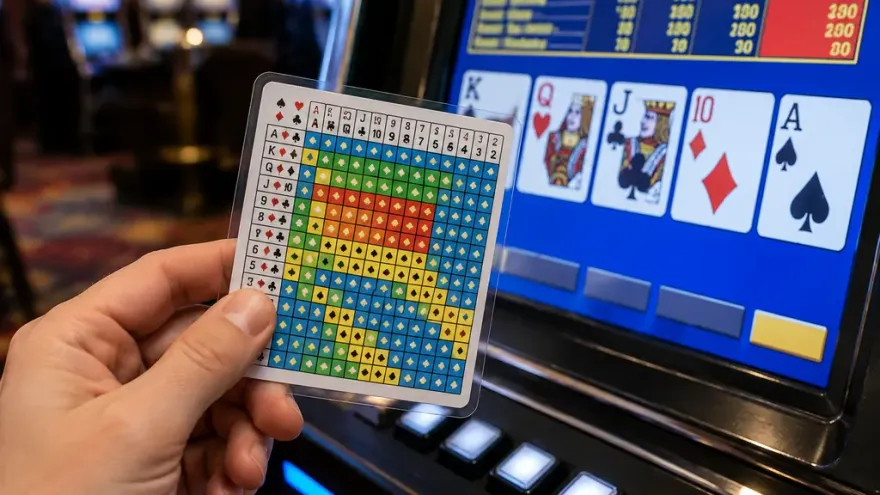
A strategy chart doesn't rank hands by feel. It ranks every hold available on a given five-card deal by expected value, calculated once, by computer, across every possible draw that hold could produce. The chart later in this guide reflects that exact ranking for 9/6 Jacks or Better, the benchmark full-pay table most strategy cards are built around.
The single biggest leak in a video poker player's return is playing a hunch instead of the chart. Breaking a made pair to chase a flush because it "feels close," or holding an unrelated high card "just in case," quietly bleeds expected value on nearly every hand where it happens. Real-world deviation from perfect strategy typically costs between 0.5 and 2 percentage points of return, depending on how often a player departs from the correct hold. On a game already running close to break-even, that gap is the difference between a 99.5% machine and one running closer to 98%.
Nothing about that gap requires card-counting skill or a photographic memory. It requires knowing the ranking and sticking to it, hand after hand, even when a worse hold looks tempting.
Pick the Right Pay Table First: It Matters More Than Any Single Hold
Two machines can share the same name, Jacks or Better, and sit side by side on the same casino floor with a 2.24-percentage-point gap in return. The difference lives entirely in the pay table. It's how much the Full House and Flush pay per coin bet. In 2026 that gap hasn't gone anywhere, and checking the pay table on the glass or the paytable screen before the first hand still matters more than any single hold decision that follows.
| Variant | Pay table | RTP (perfect play) | Notes |
| 9/6 Jacks or Better | Full House 9-for-1, Flush 6-for-1 | 99.54% | The benchmark full-pay table; look for "9/6" on the glass |
| 8/5 Jacks or Better | Full House 8-for-1, Flush 5-for-1 | 97.30% | Same name, same rules, 2.24 points worse |
| Full-pay Deuces Wild | 25-15-9-5-3-2 structure | 100.76% | Rare online; four of a kind pays 5-for-1 on full pay |
| Bonus Poker (8/5) | Boosted aces, 2s, 3s, 4s | 99.17% | Trades some pair value for four-of-a-kind bonuses |
| Double Bonus Poker (10/7) | Full House 10-for-1, Flush 7-for-1 | 100.17% | Bigger four-of-a-kind bonuses, higher variance |
The number after the slash matters more than the name printed on the machine. A player who spots the pay-table difference on the glass has already fixed the single largest error available. This one distinction outweighs any hold decision that follows.
The 9/6 Jacks or Better Strategy Chart
The chart below applies specifically to 9/6 Jacks or Better. Deal a hand, find the highest tier the cards match, and hold that. Nothing else.
The top tier rarely shows up. A dealt royal flush, straight flush, or four of a kind gets held in full, with nothing drawn. Four cards toward a royal flush outrank everything below them, including a made full house, because the royal's 800-for-1 payout carries enough weight that even a long-shot draw toward it beats a smaller, certain win.
From there the chart works down through made hands and strong draws. A full house, flush, straight, or three of a kind beats four cards toward a straight flush. Two pair beats a single high pair of jacks or better. Three cards toward a royal flush beats four cards toward an ordinary flush, and four cards toward that flush beat a low pair held on its own. Lower still sit four cards toward an open-ended straight, two suited high cards, three cards toward a straight flush, two unsuited high cards, and a single high card held alone. If none of that matches the deal, draw five new cards.
Hold the pair, discard the kicker, every time a made pair and an unrelated high card compete for the same hold. That single rule prevents the most common beginner error on this chart, and it applies whether the kicker is an ace or a two.
A royal flush under this exact strategy shows up roughly once every 40,391 hands. That number sets realistic expectations before anyone sits down expecting a quick hit. The chart's job is maximizing long-run return across thousands of hands, not manufacturing a royal on demand.
Always Bet Max Coins
Betting fewer than five coins quietly breaks the strategy chart's math, because the royal flush payout doesn't scale evenly with the coins played. On a one-credit denomination, a royal flush pays 250 credits per coin on bets of one through four coins, a flat, linear payout the whole way. Bet the fifth coin and the payout jumps to 800 per coin, 4,000 credits total for five coins. This is more than the 3,200 that a flat rate would predict.
| Coins bet | Royal flush payout (1-credit denomination) |
| 1 coin | 250 credits |
| 2 coins | 500 credits |
| 3 coins | 750 credits |
| 4 coins | 1,000 credits |
| 5 coins | 4,000 credits |
That jump alone adds roughly 1.5 percentage points to the game's overall return, because the royal flush, however rare, carries enough weight in the payout table to move the whole RTP figure. Skip the fifth coin and bet only four, and the game's actual return suffers. A strategy chart built for a 99.54% game ends up running closer to 98% when the fifth-coin bonus is missed.
A player uncomfortable committing five coins at a dollar denomination has one correct fix. Drop to a smaller denomination, such as 25 cents or a nickel, and keep betting all five coins there. Five coins, every hand, at whatever denomination fits the budget.
A smaller denomination with all five coins in play still captures the full royal-flush bonus; a higher denomination with fewer than five coins does not, no matter how large the individual coin value looks on the bet meter.
Deuces Wild and Bonus Variants: When the Math Flips in Your Favor
Full-Pay Deuces Wild
Full-pay Deuces Wild is one of the rare video poker variants where perfect play pushes the mathematical edge onto the player, returning 100.76% over the long run. That player-favorable math is exactly why it's hard to find online. Most casinos offer a short-pay version instead, trimmed down to NSU ("not so ugly") or worse, which erases the player edge while keeping the same name on the game list.
Spotting the real full-pay table takes one hand. Check how four of a kind pays. On the full-pay structure, a non-wild four of a kind pays 5-for-1. A short-pay version drops that to 4-for-1, a one-coin cut that looks trivial until it's multiplied across every four-of-a-kind hand a player hits over a session.
Deuces Wild strategy requires its own chart, entirely separate from Jacks or Better's. Every deuce dealt changes which holds carry the highest expected value, since a wild card can complete hands a natural deck never could on the same five cards. A player who sits down at Deuces Wild and applies a Jacks or Better chart from memory is playing against the wrong math from the first hand.
Bonus Poker and Double Bonus Poker
Bonus Poker trades a little pair value for bigger four-of-a-kind payouts. The full-pay version returns about 99.17% with optimal strategy. Its incentive structure, built around bigger payouts for four of a kind, differs from standard Jacks or Better. Hitting four aces, twos, threes, or fours pays considerably more than the equivalent hand on a Jacks or Better table.
Double Bonus Poker pushes that trade further. The 10/7 full-pay structure, Full House at 10-for-1 and Flush at 7-for-1, returns 100.17% with perfect play, another of the handful of player-favorable tables available. Variance climbs alongside that return. Bigger four-of-a-kind jackpots mean longer stretches between significant hits, so a session can run cold for longer even while the long-run math favors the player.
Both of these numbers carry the same qualifier as Deuces Wild's 100.76%. They assume perfect, variant-specific strategy applied on every hand. A pair that's correct to hold on a standard Jacks or Better machine can be the wrong hold on a Bonus Poker machine paying a premium for four-of-a-kind hands, because the expected value of drawing toward that bonus payout shifts the whole ranking.
Common Video Poker Strategy Mistakes
Five mistakes account for most of the gap between a player's actual return and the number printed in a strategy guide.
Holding the kicker tops the list. Keeping an unrelated high card alongside a made pair, two jacks and a stray ace, for example, feels like insurance. It does nothing for the hold's expected value, and the correct play is the pair alone, with everything else discarded.
Chasing the gutshot is close behind. An inside straight draw, four cards needing one specific rank to complete, has only four cards left in the deck that can complete it. An open-ended straight draw has eight. Treating those two draws as equally worth chasing is a near-universal loser on the strategy chart.
Borrowing the wrong chart causes damage on a different scale. A Jacks or Better chart doesn't transfer to Deuces Wild, Bonus Poker, or Double Bonus Poker. Each pay table changes which holds carry the highest expected value, so the chart has to match the exact machine and its specific pay structure.
Skipping the pay-table check matters before a single hold decision even happens. Sitting down at a video poker machine without checking whether it's 9/6 or 8/5 Jacks or Better means playing blind to a 2.24-percentage-point swing.
Betting short of max coins rounds out the list. Four coins instead of five quietly erases the royal flush's non-proportional payout jump and the roughly 1.5 points of return that come with it.
No single one of these mistakes looks dramatic on any individual hand. Across a thousand hands, they compound into the difference between a game that's nearly break-even and one quietly handing the house an extra two or three percent.
Where to Play Video Poker Online
Video poker sits in the same software libraries as slots at most licensed online casinos, usually filed under its own dedicated tab, separate from slot titles. Online casinos with a deep video poker selection typically carry several Jacks or Better variants alongside Deuces Wild and the Bonus Poker family covered above, though the exact pay table on each specific game still needs checking, the same way it would on a casino floor. Players who want a dealt-card experience with a live dealer can look at live-dealer table games as the closer online equivalent, though those tables don't offer the fixed pay-table math this strategy chart relies on.
Two operators worth checking for a broad video poker and table-games library are Jackpot City Casino and Royal Vegas Casino, both of which carry multiple video poker variants alongside their slot catalogs. Confirm the pay table on each specific game before playing, since the same casino can host both a 9/6 and an 8/5 Jacks or Better machine side by side.
None of this changes what video poker is at its core. It's a game of chance with a calculable return. Perfect strategy minimizes the house edge. It doesn't manufacture a guaranteed win on any single session. This guide is for players 18+ (or the legal gambling age in your jurisdiction, whichever is higher). Treat it, like any casino game, as entertainment with a clear budget in mind. Cap how much goes in before sitting down, resist chasing a loss with bigger bets afterward, and use a casino's self-exclusion tools if play ever stops feeling fun.
FAQ
What is the best video poker strategy for beginners?
Does video poker strategy really improve my odds?
Which full-pay video poker game is worth learning first?
Why does betting max coins matter in video poker?
Is Deuces Wild better than Jacks or Better?
Can I memorize a video poker strategy chart, or do I need a card?
What is the house edge on 9/6 Jacks or Better?
Does online video poker use the same odds as a casino floor machine?
Related Articles