Roulette Strategy 2026: Betting Systems, Odds, and Bankroll Rules That Actually Help


A roulette strategy is a bet-sizing and bankroll plan for managing your money through sessions. Every spin is independent of the last, so the house edge and the odds of the next result hold steady regardless of progression systems, "hot number" patterns, or wheel-watching tricks. What a good strategy actually does is control how fast you can lose, how long your money lasts, and which bets give you the best mathematical shot at a session that goes your way. This guide covers the real math behind roulette odds, six popular betting systems, and the bankroll rules that make a session last longer.
Why No Roulette Strategy Beats the House Edge

Every spin of a roulette wheel is a fresh, independent event. The ball doesn't remember that red came up five times in a row, and the wheel carries no grudge against black. Waiting for a number to be "due" describes the gambler's fallacy, the mistaken belief that past results shift future odds. They don't.
- House edge
- The built-in mathematical advantage a casino holds on a bet, expressed as a percentage of each wager the game is expected to keep over the long run.
- Gambler's fallacy
- The mistaken belief that past spins change the odds of the next one, even though each spin of a fair wheel is a fully independent event.
The next spin never knows what the last one did.
The house edge comes directly from the payout table itself, a simple product of ordinary math. A single-number bet on a European wheel pays 35 to 1. The true odds of hitting that specific number are 36 to 1 against you. That one-unit gap between what the bet pays and the actual odds is where the casino's edge lives. It applies to every bet on the table, from a single straight-up number to an even-money color bet, holding steady no matter how the chips are stacked.
A betting system like Martingale or Fibonacci controls your bet size and timing. The wheel itself operates the same way regardless. Doubling a bet after a loss doesn't make the next spin any more likely to land on red. Systems affect your session's flow, how long a bankroll lasts, and how large bets can grow before the table limit is hit. The edge built into the wheel, covered in the table below, stays unchanged by any progression.
European vs American vs French Roulette: Which Wheel to Play
Not all roulette wheels play the same game in disguise. European roulette uses a single zero on a wheel with 37 total pockets. American roulette adds a second zero, for 38 pockets total, which roughly doubles the house's advantage on every standard bet. French roulette runs on the same European wheel, but some tables add La Partage or En Prison rules, which return half a losing even-money bet, or keep it in play for one more spin, when zero hits.
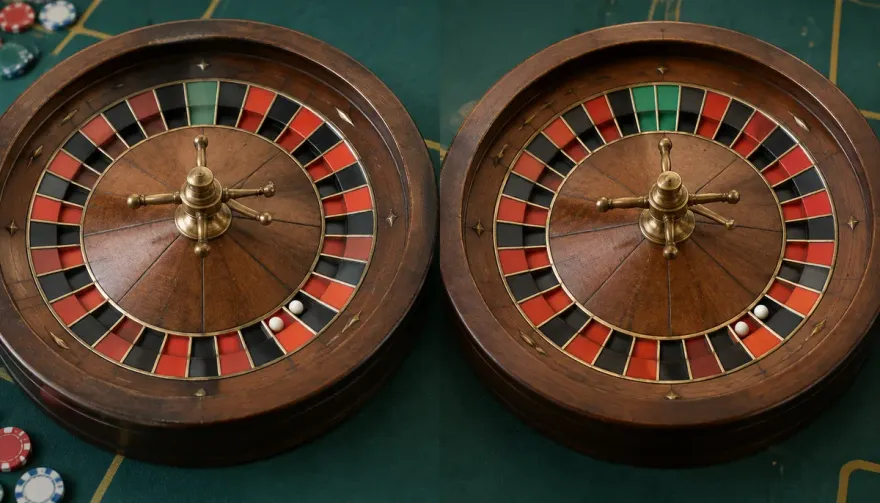
That single rule can cut the already-low European edge in half again on certain bets.
| Wheel | Pockets | House edge (standard bets) | Notes |
| European | 37 (single zero) | 2.70% | Most common online; the default choice when it's available |
| American | 38 (double zero) | 5.26% | The extra zero roughly doubles the house edge |
| French | 37 (single zero) | 2.70% standard bets; 1.35% even-money bets under La Partage/En Prison | Same wheel as European, better rules on even-money bets where offered |
Wheel choice is the single biggest lever a player controls before a chip ever touches the felt. Moving from American to European or French roulette cuts the expected loss on a fixed amount of total action by roughly half. A typical session wagering $10,000 on the European wheel costs around $270 in expected losses. The same $10,000 on an American table costs nearly twice as much. That's a bigger, more reliable swing than any betting system on this page produces, regardless of how disciplined the progression. If a casino offers both wheels, the European or French table is close to a free upgrade.
Roulette Bets and Payouts Explained
Every bet on a roulette table falls into one of two groups. Inside bets sit directly on numbers or small clusters of numbers. Outside bets cover broader categories, like color, range, or parity. Inside bets pay more because they cover less ground; outside bets pay less because they hit far more often.
Payout odds stay constant across wheels, while probability moves with the pocket count.
| Bet type | Payout | European probability | American probability |
| Straight up (1 number) | 35:1 | 2.70% | 2.63% |
| Split (2 numbers) | 17:1 | 5.41% | 5.26% |
| Street (3 numbers) | 11:1 | 8.11% | 7.89% |
| Corner (4 numbers) | 8:1 | 10.81% | 10.53% |
| Six line (6 numbers) | 5:1 | 16.22% | 15.79% |
| Dozen / Column (12 numbers) | 2:1 | 32.43% | 31.58% |
| Even-money: red/black, odd/even, high/low (18 numbers) | 1:1 | 48.65% | 47.37% |
Outside bets hit close to half the time and pay even money, which is why most players lean on them to stretch a session without big swings. Inside bets hit rarely, sometimes under 3% of spins for a single number, but pay well enough to recover a run of losses in one result. A street or corner bet sits in the middle ground, with moderate odds, payout, and swings. What matters is that all bets carry the same house edge mathematically, regardless of how different they feel in terms of frequency and payout size.
The Most Popular Roulette Betting Systems
Betting systems control the bet pattern while leaving the underlying odds fixed. The six described below are the ones most players encounter first at a live or online table. Each one answers the same question in a different way. How much do you bet after a win, and how much after a loss? Some turn that question into something aggressive. Others keep it nearly flat.
The house edge underneath all six stays exactly where it started.
Martingale
Martingale is the oldest and most aggressive roulette system. You double the bet after every loss on an even-money wager, then drop back to the base bet after a win. The logic is straightforward. A single win at any point recovers every prior loss in the sequence plus one unit of profit. A losing streak forces bets to grow exponentially. Even a short sequence of consecutive losses—which happens more often than most players expect—can push a bet past the table maximum or deplete the bankroll. Martingale works fine on paper until the streak that breaks it.
Reverse Martingale (Paroli)
Paroli flips the Martingale approach. The bet doubles after a win, then resets to the base bet following a loss or after a set run of wins (commonly three in a row). Because losses stay capped at the base bet, a bad run costs far less than it would under Martingale. The same doubling-after-wins mechanism that keeps losses small also puts a ceiling on how much a single winning streak can earn.
Fibonacci
The Fibonacci system borrows its progression from the famous math sequence, where each step is the sum of the two before it. Move one step forward after a loss, two steps back after a win. Bet growth is slower than Martingale's doubling. That makes a short losing streak less painful. But the sequence is still unbounded, and a long enough run of losses eventually produces the same table-limit problem Martingale has, just a few spins later.
D'Alembert
D'Alembert is the gentlest of the common progressions. Add one unit after a loss, subtract one unit after a win. Where Martingale can turn a five-spin losing streak into a bet 32 times the original stake, D'Alembert turns the same streak into a bet only five units higher. Lower variance is the whole appeal, since each loss adds only one unit to the next bet, a gentle climb compared with Martingale's doubling. The house edge sitting underneath every spin stays exactly the same either way.
James Bond
The James Bond strategy is a flat-bet system named for its fictional namesake's table manners. Place a single bet covering a wide stretch of the wheel in one spin. It divides a stake across three separate bets to maximize coverage. It feels like a system with better odds because so many numbers win, even though the weighted payouts average out to the same house edge as any other bet combination. The uncovered portion of the wheel loses the full stake.
Labouchere
Labouchere, also called the cancellation system, starts with a written sequence of numbers that replaces a single flat stake. Each bet equals the sum of the first and last numbers in that sequence. A win crosses off both numbers. A loss adds the lost amount to the end of the sequence instead. The goal is clearing the whole list. It's the most complex system here to track at a live table, and like the others, a bad run can stretch both the sequence and the bet size in a direction that's hard to recover from.
Arranged by approach, the six systems fall into two distinct camps. Aggressive progressions chase losses fast, while gentler ones spread risk over more spins.
| System | Bet pattern | Risk/volatility | Best for |
| Martingale | Double after a loss | High, exponential growth | Short sessions, high risk tolerance |
| Paroli (Reverse Martingale) | Double after a win | Moderate, losses capped at base bet | Players who want limited downside |
| Fibonacci | Step forward after a loss, two back after a win | Moderate to high, slower but still unbounded | Players who want Martingale's logic with less speed |
| D'Alembert | +1 unit after a loss, -1 unit after a win | Low, gentle linear progression | Longer sessions, lower variance |
| James Bond | Flat bet, wide wheel coverage | Moderate, frequent small wins, occasional full loss | Players who dislike empty spins |
| Labouchere | Bet equals sum of sequence ends, sequence adjusts | High, size tied to how the sequence develops | Players willing to track bets carefully |
All six share the same ceiling, the house edge sitting underneath every one of them. They're six different ways to decide how much to risk on the next spin, and the right pick depends on how much volatility a given session can tolerate.
Bankroll Management Rules That Actually Help
Bankroll management is the one part of roulette strategy that holds up under real math, because it controls the one thing a player actually controls. That's how much to risk and when to stop. A loss limit and a win target work best set in advance, while the decision is still clear-headed and unaffected by whatever the next few spins do.
Size individual bets as a small, fixed percentage of your session bankroll, commonly cited as a 1 to 5% range. A modest base bet gives a losing streak plenty of room to run before it threatens the whole session. A Martingale run that starts small can still double past a sizeable chunk of that same bankroll after just a handful of consecutive losses, which happens more often than many players expect. Smaller base bets buy time, and time is what lets the math of a session play out closer to its expected shape. This protects the bankroll and extends how long a player can enjoy the game, all without changing the house edge.
Stop when either limit is hit. A win target serves as the primary mechanism that locks in a good session before variance gives it back. Chasing losses past a pre-set stop point is how a manageable loss turns into a damaging one, and it's the single most common way a bankroll plan falls apart in practice.
Common Roulette Mistakes to Avoid
Most roulette losses that sting in hindsight trace back to one of five habits.
- Chasing losses. Raising a bet past the plan specifically to win back what's gone is how one bad spin turns into a ruined session.
- Betting on "hot" numbers or patterns. Streaks, repeating numbers, and visible wheel patterns carry zero predictive value, since each spin is independent of the last.
- Playing American when European is available. Picking the double-zero wheel out of habit nearly doubles the house edge for no benefit.
- Skipping a session limit. Sitting down without a stop-loss and a win target turns a plan into a guess.
- Scaling a system past the table maximum. A Martingale or Labouchere run that hits the table's bet cap stops working at the exact moment it needs to keep doubling, leaving a loss with no way to recover inside the system.
These mistakes share a pattern worth noticing. Each one trades a plan for an impulse, whether that's scaling a bet past the table's cap or staying at a table long after a stop-loss should have ended the session. They're decision-making habits that show up in any game built on variance, roulette included. A player who avoids all five improves their session length and preserves their bankroll, matching what the math already predicts.
Where to Play Roulette Online
Picking a table matters as much as picking a system, maybe more. Our guide to playing roulette covers the basics of placing bets and reading the table if that's still unfamiliar. From there, wheel choice and bankroll discipline are the two things actually worth optimizing.
Wheel choice still comes first.
For a side-by-side look at operators built around live roulette specifically, our best online roulette casinos hub ranks sites by table variety, minimum bets, and European-wheel availability. Live-dealer tables deserve your attention for wheel selection, since each stream broadcasts one fixed physical wheel instead of drawing from theoretical random-number odds. Our live casino guide breaks down what to expect from a live table versus an RNG one. Among single-brand options, Jackpot City, CasinoChan, and PlayAmo all carry multiple European-wheel live roulette tables, which is the detail worth checking before the size of the welcome bonus. None of that changes the math from earlier in this guide; it puts the better wheel in front of you by default.




This guide is for players 18+ (or the legal gambling age in your jurisdiction, whichever is higher). Treat gambling as entertainment. Set a deposit limit before playing, keep a bankroll limit non-negotiable once it's hit, and use a casino's self-exclusion tools if a session stops feeling fun. That holds regardless of which strategy or casino bonus is in play.
FAQ
Does any roulette strategy guarantee a win?
What is the best roulette strategy for beginners?
Is the Martingale system illegal or banned?
European or American roulette, which has better odds?
How much bankroll do I need to play roulette?
Can casinos rig online roulette?
What is the safest roulette bet?
What is the James Bond roulette strategy?
Related Articles

100 Free spins casino