Payment method
Crypto Casinos
Crypto works at online casinos the same way it works anywhere else. You send coins from a wallet you control, the network confirms the transfer, and the casino credits your balance once enough of those confirmations have stacked up. No card number changes hands. No bank sits in the middle approving or delaying anything. That directness appeals to plenty of players, and it also creates the friction you'll feel if you've never bought crypto before. Deposits and withdrawals work in straightforward ways once you understand which coins Australian-facing casinos support most, what each costs, and where crypto genuinely holds up against a bank transfer or PayID versus where it falls short.
Top Crypto Casinos for Australian Players
We track 187 casinos on this site that accept crypto as a deposit and withdrawal method. That's a meaningfully bigger pool than most single-payment-method pages here, because crypto isn't tied to one bank or one country's rails; a casino licensed to serve Australian players can add Bitcoin or Litecoin support without needing a local banking partnership at all. The live table below pulls from that same list and adjusts automatically for what's actually available to you.










What Are Crypto Casinos and How Do They Work?
A crypto casino is an ordinary online casino, same games, same licensing requirements, that also lets you fund your account with cryptocurrency alongside a card or bank transfer. The deposit itself runs on a blockchain. You send coins to a wallet address the casino generates for you. There's no card number involved anywhere in that transfer.
People misunderstand the anonymity claim. Crypto transactions are pseudonymous rather than truly anonymous. Every transaction is visible on the public blockchain, tied to a wallet address. The casino still knows who you are once you've registered and verified your account. Your bank never sees the transaction. The casino, and anyone who can trace that wallet address back to you, still can. That distinction matters more than most crypto marketing copy admits.
Two ownership models sit underneath the deposit. In a custodial setup, an exchange like Binance or CoinSpot holds your private keys and you access your coins through a login and password, much like a bank account. In self-custody, you hold the private keys yourself, usually through a wallet app like MetaMask or Trust Wallet, and nobody can move that money without your signature. Casinos don't care which model you use to send the deposit. You should, though, because it changes who's actually responsible if something goes wrong with your holdings.
How to Deposit with Crypto
- Register at the casino and verify your email address.
- Get crypto into a wallet you control, either by buying it on an exchange (Binance, CoinSpot, and Kraken all serve Australian users) or transferring in coins you already hold.
- Open the casino's cashier, pick your coin, and copy the wallet address it generates, or scan the QR code on your phone.
- Enter the amount and send the transfer from your wallet.
- Wait for network confirmations. The casino credits your balance once the blockchain confirms enough blocks, which takes a little longer than the moment you hit send.
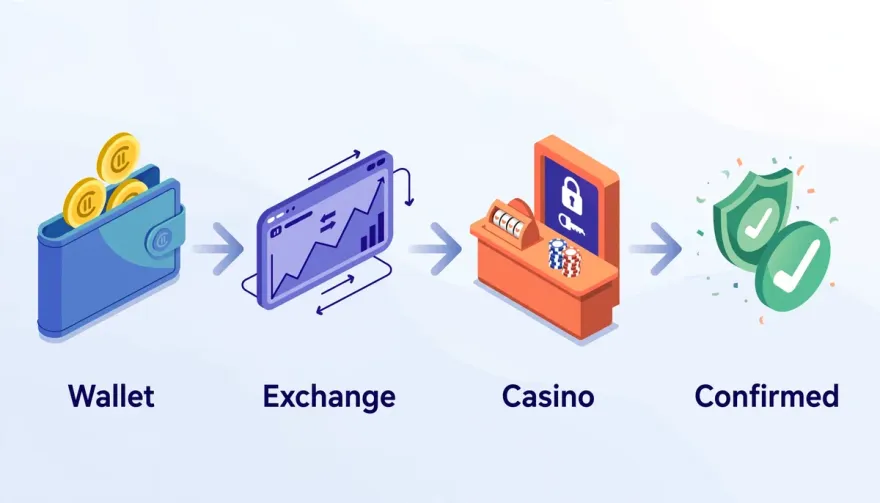
First-timers usually misjudge that last step. Sending the coins takes seconds. Getting them recognised as final takes longer, and how much longer depends entirely on which coin you're using and how busy that network is right now.
How to Withdraw Crypto Winnings
Withdrawals reverse the deposit flow. Most of the delay sits on the casino's side, not the blockchain's.
- Open the cashier and select crypto withdrawal.
- Paste the wallet address you want the funds sent to. It has to be an address you control.
- Confirm the amount and submit the request.
- The casino reviews and releases the withdrawal internally. This is where identity checks, fraud screening, and manual approval queues live, and it's usually the slowest part of the whole process.
- Once released, the transaction moves across the network like any other crypto transfer, landing in your wallet after enough confirmations.
No single number covers every case. A Bitcoin transaction typically needs more confirmations than a Litecoin or Dogecoin one to be treated as final, so the same casino can feel noticeably faster on one coin than another purely because of network mechanics, before you even factor in how quickly that specific casino processes its side of the queue.
Fees, Limits and Speed
Crypto fees split into two separate buckets that people often lump together. What the network charges to move the transaction is separate from what the casino charges (or doesn't) for processing it.
| Coin | Network confirmation speed | Network fee | Casino-side fee |
|---|---|---|---|
| Bitcoin | Slower, more confirmations typically required | Can rise sharply when the network is busy | Usually none |
| Ethereum | Faster than Bitcoin | Variable, moves with network demand | Usually none |
| Litecoin | Fast | Low | Usually none |
| Bitcoin Cash | Fast | Low | Usually none |
| Dogecoin | Fast | Very low | Usually none |
| Bitcoin Lightning | Near-instant | Minimal | Usually none |
Most crypto-friendly casinos don't charge their own deposit fee at all. The network fee is the one you actually feel, and it moves with network congestion, something no casino controls. Minimum deposits tend to sit lower than card or bank-transfer minimums too, since a casino accepting crypto doesn't need to protect against the chargeback risk that drives card minimums up in the first place.
Popular Coins at Crypto Casinos
Not every coin gets equal support. Support levels vary significantly by coin across the casinos we track.
| Coin | Casinos accepting it |
|---|---|
| Bitcoin | 123 |
| Ethereum | 95 |
| Litecoin | 90 |
| Bitcoin Cash | 48 |
| Dogecoin | 47 |
| Bitcoin Lightning | 5 |
Bitcoin remains the default. It's the coin every crypto casino builds support for first, largely because it's the one most players already own, even though its network can be the slowest and priciest of the group during busy periods.
Ethereum sits a close second, popular partly because a lot of players hold it from other crypto activity and partly because its confirmation times run faster than Bitcoin's under normal conditions.
Litecoin punches above its market-cap weight here. It was built specifically for faster, cheaper transfers than Bitcoin, and that design goal happens to line up exactly with what a casino depositor wants. If a casino supports both Bitcoin and Litecoin, I'd point Australian players toward Litecoin for the network fee difference alone.
Bitcoin Cash and Dogecoin trail behind but still show up at roughly a quarter of the casinos we track, both riding the same low-fee, fast-settlement logic as Litecoin. Bitcoin Lightning, a faster payment layer built on top of the Bitcoin network, is rare here (5 casinos) but near-instant when it's offered.
Stablecoins like Tether (USDT) exist as an option at a number of operators too, valued because their value is pegged to the US dollar and doesn't swing while your deposit is sitting in transit. Stablecoin support remains scattered across operators and isn't yet uniformly documented. Treat it as an emerging option for now.
Pros and Cons of Crypto at Casinos
Crypto doesn't solve payments outright; it trades one set of trade-offs for another. Crypto genuinely helps in some scenarios and asks more of you than a card or PayID would in others.
| Pros | Cons |
|---|---|
| Deposits often settle faster than a bank transfer once the network confirms | Coin value can move while your deposit or withdrawal is in transit |
| No card or bank account number shared with the casino | Getting started means owning crypto first, an extra step compared with a card |
| Works at casinos regardless of local banking partnerships | Not every casino supports crypto withdrawals as smoothly as crypto deposits |
| Wide operator support, 187 casinos and counting on this site alone | Steeper learning curve than PayID or a card for a first-time depositor |
Volatility works against you in a concrete way. Deposit $100 in Bitcoin and the price drops 4% before the casino confirms it, and your account can be credited for less than $100 in local-currency terms, depending on how the casino values the transaction. That's just how a fluctuating asset behaves as a payment rail. Every crypto casino deals with the same mechanic.
Is It Safe to Gamble with Crypto in Australia?
Is the casino safe, and is your crypto safe? Those are two distinct questions with two different answers.
For the casino side, stick to operators holding a recognised gambling licence and treat crypto support as one feature among several, on top of the due diligence you'd do anyway. Blockchain transparency helps here in one specific way. Transaction records are public and permanent, so a casino can't quietly alter a deposit or withdrawal record the way a private ledger entry could theoretically be adjusted.
For the wallet side, the rules are the same ones that apply to holding crypto anywhere. Never share your seed phrase with anyone, including anyone claiming to be casino support. If you're buying crypto for the first time, use a reputable, established exchange. Skip unfamiliar apps you found through an ad. If you're using self-custody, back up your recovery phrase somewhere that isn't a screenshot on your phone.
Crypto winnings can carry tax implications depending on where you live and how your local tax authority treats crypto-asset transactions, and that's genuinely worth a real conversation with a tax professional. Gambling itself should stay entertainment regardless of payment method. Set a deposit limit before you start, avoid chasing losses, and use self-exclusion tools if a session stops feeling like fun. Must be 18+ to gamble.
Crypto vs Other Australian Payment Methods
None of these methods is universally best; each one trades speed, setup effort and reach differently. Crypto compared to the other rails Australian players actually use:
| Method | Typical speed | Fees | Availability | Best for |
|---|---|---|---|---|
| Crypto | Deposits often within minutes; withdrawal speed depends on casino processing plus confirmations | Network fee only; casino side usually free | International, works at any crypto-friendly casino | Players who already hold crypto and want a bank-free rail |
| PayID | Near-instant, bank-to-bank | Free | Tied to an Australian bank account | Straightforward AUD deposits without touching an exchange |
| Bank transfer | Slower, can run a business day or more each way | Usually free | Broad | Larger, planned deposits where speed isn't the priority |
| E-wallets (PayPal, Skrill) | Fast on deposit; withdrawal speed varies by casino | Sometimes a small fee | Depends on casino support | A wallet layer between your bank and the casino |
PayID wins on simplicity for anyone who just wants AUD in and AUD out without an extra account to manage. Crypto wins when you already hold coins, want to move money across a casino's licensing borders without a local bank in the loop, or care more about settlement speed than about the extra setup step. Neither one is objectively better; they solve different problems.
Crypto Casino Alternatives
If crypto's extra setup step isn't for you, Australian players have several faster on-ramps that skip the exchange account entirely. PayID moves money bank-to-bank in seconds and is worth checking against our full payment methods hub for the current list of supported casinos, or our dedicated PayID casinos in Australia guide for the local rundown. Bank transfer remains the slowest but most familiar option, covered on our bank transfer casino guide. PayPal and Skrill sit somewhere in between, fast on deposit with withdrawal speed that varies by operator. If Bitcoin specifically is your main interest, our Bitcoin casinos page narrows the list down to that one coin.
If your priority is avoiding ID verification altogether, that's a narrower question we address separately, and we've got a dedicated guide on that angle in the works. The same applies to players chasing privacy from the casino itself; that's a separate topic we cover elsewhere.
How We Rank Crypto Casinos
Every casino in the table above goes through the same six-point check before it earns a spot. We weigh licensing and regulatory standing, the range of coins actually supported (not just advertised), deposit and withdrawal speed as reported by the casino and cross-checked where possible, network and casino-side fees, the size and quality of the game library, and how responsive support is when a crypto transaction needs a human to look at it. A casino that nails the game library but stalls crypto withdrawals for days doesn't rank well here, no matter how big its welcome bonus looks.
FAQ
What is a crypto casino?
Is it legal to gamble with crypto in Australia?
Which cryptocurrencies do Australian-facing casinos accept?
Is crypto gambling safe?
What's the minimum crypto deposit at these casinos?
Do crypto casinos support withdrawals as well as deposits?
How does crypto compare to PayID for Australian players?
Do I pay tax on crypto casino winnings?
Never miss a bonus

- Trusted by playersReviewed by real players
- Exclusive bonusesOnly the best deals
- Fast payoutsQuick & secure withdrawals
- 24/7 SupportWe're here to help