First Deposit Bonus


Every online casino wants your first deposit, and the bonus attached to it is usually the biggest incentive on the site. It sits alongside no-deposit offers, standalone free-spins promos, and free-play slots you can try with no money down at all, but a first deposit bonus works differently. You have to put your own money in first, before any bonus funds show up. Casinos structure it this way on purpose. Before you pick a casino based on the size of the number in the banner, it helps to know what that number actually means and what it costs you to unlock it.



















Those are live offers currently running on the market. Before claiming any of them, know the mechanics behind the headline figure. The percentage on the banner and the amount you can realistically walk away with are two different things.
What Is a First Deposit Bonus?
A first deposit bonus is extra credit a casino adds to your account once you fund it for the first time, calculated as a percentage of whatever you deposit. A "100% match up to $500" means the casino doubles whatever you put in. The $500 cap is fixed, so depositing beyond it doesn't buy any extra bonus funds. Put in $200 and you get $200 extra. Put in $600, though, and you still only get $500, because the cap doesn't move.
The match percentage is the headline number, but it's only half the story. Casinos run these bonuses because a first deposit is the single biggest predictor of whether a new player sticks around. A bigger match pulls more signups than a smaller one, so operators compete on the number at the top while quietly controlling the real cost through the rules underneath it. Understanding that balance puts you in a better position to judge an offer than the banner percentage alone does.
Match bonuses differ from no-deposit offers in one practical way. You're risking your own money from the first spin. A no-deposit bonus costs you nothing to try. A first deposit bonus means your initial stake is already in play before any bonus funds appear, so the minimum deposit requirement and the wagering terms matter more here than they would on a freebie.
Types of First Deposit Bonuses
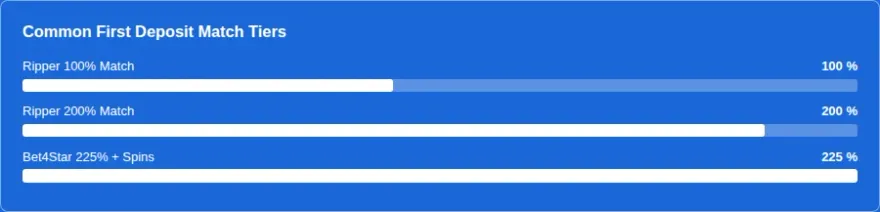
Not every first deposit bonus is structured the same way, and the differences change how much work you need to put in before you see any of it as withdrawable cash.
Match-only bonuses. The casino matches a percentage of your deposit in bonus funds, full stop. Ripper Casino, for instance, runs several of these tiers at once. One tier offers a 100% match capped at $800. The minimum deposit for that one is £45. Separately, there's a 200% match up to $1,000. That one only needs a £25 deposit to unlock.
Match plus free spins. Here the casino pairs the percentage match with a set number of spins on a specific slot or slot selection. Bet4Star Casino currently runs a 225% match plus 500 free spins, for example. The deposit needed to unlock it starts at £30.
Tiered or milestone deposits. Some operators split the welcome offer across your first several deposits rather than loading it all onto deposit one. Deposit one might unlock the biggest match, deposit two a smaller one, and so on, spreading the bonus budget out to keep players depositing over the first week instead of walking away after a single session.
Match percentages across the market commonly range from around 100% up to well above 200%, though the number alone tells you little without the wagering requirement attached to it. A bigger headline match can still end up the tougher offer to clear if its wagering multiplier runs higher than a smaller bonus sitting right next to it. Read both figures side by side before deciding which one is the better deal.
How to Claim a First Deposit Bonus
The claim process is similar across most licensed casinos, with small variations depending on the operator.
- 1. Register an account. Standard signup. Email, a password, basic personal details, and some casinos ask for a phone number too.
- 2. Verify your identity. Most operators run at least a light KYC check before your first withdrawal, and a few ask for ID upfront. Get this out of the way early so it doesn't hold up a payout later.
- 3. Make the qualifying deposit. Each promotion lists a minimum deposit amount, and depositing below it usually forfeits the bonus entirely instead of simply reducing it. Check the figure first, before you send any funds.
- 4. Enter a bonus code if one is required. Some bonuses apply automatically the moment a deposit clears. Others need a code typed into the cashier before you confirm the transaction, and missing that step can mean the deposit lands with no bonus attached at all.
- 5. Confirm the bonus credits. Check your account balance or bonus tab before you start playing. If the bonus hasn't appeared within a few minutes, contact support before you wager anything, since some operators won't retroactively add a bonus to a deposit that's already in play.
- 6. Start wagering toward the requirement. From here, every eligible bet chips away at the playthrough target attached to the bonus.

Skipping step 3 or step 4 causes more forfeited bonuses than anything else on this list. The deposit simply didn't qualify, and the casino has no obligation to credit it after the fact.
The identity check in step 2 exists because licensed casinos answer to a regulator. Depending on the operator, that might be the UK Gambling Commission, the Malta Gaming Authority, or Curaçao's licensing authority, and the license number is usually listed in the site footer. A casino with no visible license from any of these bodies is a red flag worth treating as a reason to pick a different operator.
Wagering Requirements and Terms to Check

This is the section that actually determines whether a bonus is worth claiming. Most players skip straight past it to get to the games.
The playthrough multiplier. A wagering requirement is usually written as a multiplier, like 35x. That means wagering 35 times the bonus amount, sometimes the deposit and bonus combined, check which, before you can withdraw anything tied to it. On a $200 bonus, that same multiplier works out to $7,000 in total bets before any of that money, or winnings from it, becomes withdrawable. That number is the real price of the bonus. The match percentage on the banner never tells you that part.
Game weighting. Not every bet counts equally toward that target. Slots typically contribute all of what you wager, dollar for dollar. Table games like blackjack or roulette often count for far less, sometimes down near a tenth of the stake, specifically because they carry a lower house edge and would otherwise let players clear the requirement too cheaply. Check the weighting table before assuming a session at the blackjack tables knocks the same amount off your playthrough that a session on the slot games would.
Maximum bet while wagering. Many bonus terms cap the size of any single bet you can place while a bonus is active, often around 5-10% of the bonus value or a flat amount like £5–£25. Bet above that cap and some casinos will void the entire bonus along with any winnings attached to it.
Time limits. Bonuses expire. Seven days is common for smaller promos, with some stretching to 30 days for bigger welcome packages. Whatever wagering you haven't completed when the clock runs out is forfeited, along with the bonus funds themselves.
Maximum cashout caps. Some operators cap how much you can withdraw from bonus-funded winnings, regardless of what your balance shows. A bonus with a $100 cashout limit means that's the ceiling on withdrawable winnings from that bonus, even if your account balance reads several times higher after a lucky run. This single term can matter more than the match percentage or the wagering multiplier.
None of these terms are hidden exactly. They're just rarely in the first paragraph of a promo page. Reading the full terms before depositing takes a few minutes and tells you more about what a bonus is actually worth than the number in the banner ever will.
The live offers in the table above are a reasonable place to start comparing match percentages, minimum deposits, and spin counts against each other. Just read the terms attached to whichever one catches your eye before you fund the account.
FAQ
Can I claim a first deposit bonus and a no-deposit bonus at the same casino?
Do all games count toward the wagering requirement?
Is there a time limit to clear a first deposit bonus?
Can I withdraw the bonus money directly?
Related Articles

Casino Weekend Bonus

Thursday Casino Bonus

Wednesday Casino Bonus