Best Online Casino Partners: How Casino Affiliate Programs Actually Work


A casino affiliate program pays a website, influencer, or marketer for sending a casino new players, usually through a tracked link or code that credits the signup to that affiliate's account. The payment itself comes in one of three shapes: a flat fee per qualified player (CPA), an ongoing cut of what that player loses over time (revenue share), or some blend of the two (hybrid). None of that's unique to gambling. What's different about casino programs is the regulatory layer sitting on top of the payout, the long tail a revenue share deal can run for, and the fact that a generous-looking offer and a genuinely good program are often two different things. This guide covers how the mechanics work, who actually runs these programs, and how to separate a program worth your time from one that won't be.
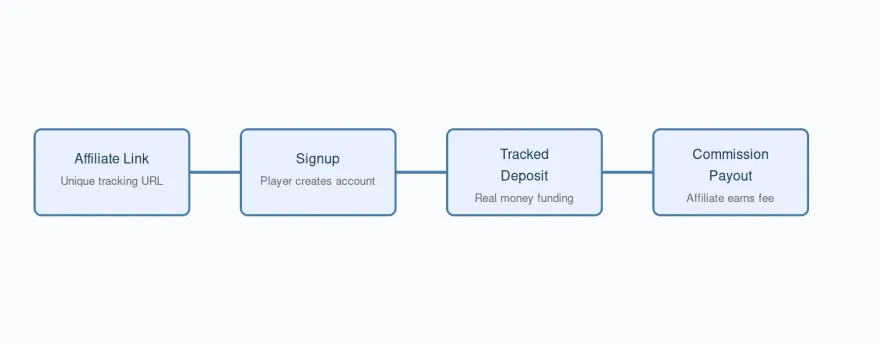
How a Casino Affiliate Program Actually Pays You
Every casino affiliate program runs on the same basic chain of events, even when the commission math behind it differs wildly. A player clicks your tracked link. A cookie or a server-side postback attaches your affiliate ID to that player's account. The player signs up, deposits, and plays. The program's tracking software logs each of those steps against your ID, and your dashboard totals it up.
The part a lot of new affiliates get wrong is assuming the click itself is what gets paid. It isn't. Most programs pay on a qualified action further down the funnel, a real deposit, a minimum wagering amount, or sometimes both stacked together. A click that never converts to a funded account earns nothing, no matter how much traffic it represents on your own analytics.
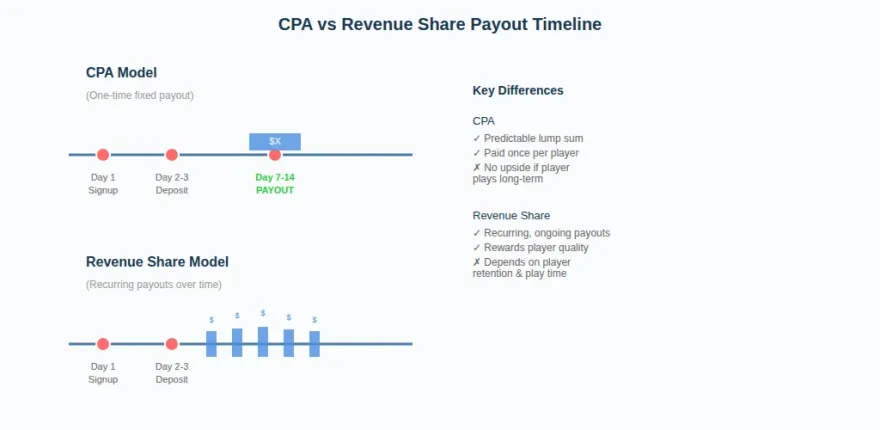
Attribution windows vary by program and by model, and the gap matters more than it sounds. A CPA deal typically runs a shorter attribution period, because the payout is a one-time event tied to that first qualifying deposit. A revenue share deal keeps paying as long as the player stays active and remains attributed to your account, sometimes for the life of that player's relationship with the operator. That's the part that makes revenue share interesting. It's also the part that makes a program hard to evaluate from the outside, since a quiet month in your dashboard doesn't tell you whether a referred player churned or just took a break.
CPA, Revenue Share, and Hybrid: The Three Models, Compared
These three terms get thrown around loosely, so it's worth being precise about what each one actually commits the operator to paying.
CPA pays a flat, one-time fee once a referred player hits whatever qualifying action the program defines, commonly a minimum deposit or a set amount of real-money wagering. Revenue share pays an ongoing percentage of that player's net losses to the casino, released on a recurring schedule for as long as the player stays active and attributed to the affiliate. Hybrid deals combine a smaller CPA payment up front with a reduced revenue share percentage behind it, trading some certainty now for some upside later. That's the entire trade.
Revenue share rates get negotiated across a genuinely wide range industry-wide, generally scaling with how much qualified traffic an affiliate can deliver and how competitive the vertical is in a given market. Treat any specific percentage you see quoted outside your own signed terms as a marketing claim worth verifying before you rely on it in planning. The real difference between the three models is how risk gets split between the affiliate and the operator.
| Model | Who carries the risk | When you get paid | Best fit |
| CPA | Operator (fixed cost regardless of player value) | Once, shortly after the qualifying deposit | High-volume traffic, affiliates who want predictable cash flow |
| Revenue share | Affiliate (payout depends on player behavior over time) | Recurring, tied to ongoing play | Affiliates confident in player quality, long-term content sites |
| Hybrid | Split between both sides | Partial upfront, partial ongoing | Affiliates who want some certainty without giving up all the upside |
A high-volume site sending a lot of casual traffic usually does better on CPA, since it gets paid regardless of whether those players stick around afterward. A site sending fewer, more engaged players, the kind who read an in-depth guide before clicking through, often does better long-term on revenue share, because that traffic tends to convert into long-term active players who return to play repeatedly.
Who Actually Runs These Programs
Not every casino affiliate program comes straight from the casino itself. A few different kinds of organizations run them, and knowing which kind you're dealing with changes what you should expect from reporting, payment reliability, and account support.
Some operators run their affiliate program in-house, under their own brand, with their own account managers handling the relationship end to end. Bet365 Partners and 888 Affiliates are both examples of a well-known operator managing its affiliate program this way.
A second group is affiliate management software providers. Companies like Affilka by SoftSwiss, Income Access, and NetRefer build the tracking and payment infrastructure that many operators license and run their own program on top of. Most programs you'll encounter use third-party affiliate management software, which tends to deliver a more polished dashboard and granular reporting than in-house builds.

A third group is multi-brand affiliate networks, which aggregate several operators under one dashboard so an affiliate can promote multiple casinos through a single login and one payment relationship. General affiliate networks like CJ Affiliate and Awin carry gambling offers in some regions too, usually as a small slice of a much broader retail and finance catalog.
None of these three structures is automatically better than the others on paper. A well-run in-house program from a licensed operator can be excellent. A network can be convenient, though it adds a layer between you and the operator that sometimes slows dispute resolution down. What matters more than which structure a program uses is its actual track record for paying on time and reporting honestly. That reputation gets discussed on affiliate forums and industry communities more reliably than it shows up on the program's own marketing page.
What Actually Separates a Strong Program from a Weak One
A bigger headline commission and a genuinely better deal aren't automatically the same thing. Four things matter far more than the percentage printed on the sales page, and none of them show up in a headline rate.
Payment reliability comes first. A program with a fixed, published payment schedule that it actually honors beats one offering a flashier rate that arrives late, gets disputed, or requires chasing an account manager by email every cycle.
Reporting transparency is second. You should be able to see clicks, signups, deposits, and revenue broken down by day. A dashboard that only shows a lump total at the end of the month doesn't give you any way to tell whether a traffic source is converting or just generating clicks that go nowhere.
Brand and geo coverage matters more than people expect going in. A program tied to a single casino brand in one market caps your upside hard. A program spanning several brands across overlapping markets lets you route traffic to whichever brand converts best for a given audience, without rebuilding your tracking setup from scratch every time.
Account management is the part people underrate until they actually need it. A responsive affiliate manager flags a tracking problem before it quietly costs you a month of commissions. One who never answers email lets that same problem run for weeks unnoticed.
| What to check | Strong program | Weak program |
| Payment schedule | Fixed, published, consistently honored | Vague, "on request," frequently delayed |
| Reporting detail | Daily breakdown of clicks, signups, deposits | End-of-month total only |
| Brand/geo coverage | Multiple brands, broad market overlap | Single brand, narrow market |
| Mobile tracking | Attribution holds across app and mobile web | Links break or lose attribution on mobile |
A program that scores well across all four of those categories is worth building a long-term relationship with even at an average headline rate. A program that scores poorly on even two of them is worth avoiding no matter what number sits on the landing page.
Licensing Isn't Just the Operator's Problem
The casino's license affects you even though you're not the one holding it. If an operator is licensed by a recognized regulator, among others the UK Gambling Commission, the Malta Gaming Authority, or the Kahnawake Gaming Commission, players you refer get real consumer protections, and the operator is less likely to disappear or get shut down mid-payout cycle. An unlicensed or loosely regulated operator can offer attractive terms on paper and still leave your commissions worthless if the brand folds or gets blocked in a key market.
Advertising rules attach to you as the affiliate publishing the promotion, separately from whatever obligations sit on the casino's own side. Most reputable jurisdictions restrict how gambling can be advertised, who it can target, and what claims can be made about winning. Promoting an operator's bonus with language a regulator would flag puts your own site at risk, on top of anything the casino itself is already exposed to.
Read the affiliate agreement's compliance section before you read the commission section. Most new affiliates skip it anyway.
A Short Checklist Before You Apply
A few questions, asked before signing up for any casino affiliate program, save a lot of wasted traffic down the line.
Check whether the operator holds a license from a regulator you recognize, and confirm that license actually covers the markets you plan to send traffic from. Ask what qualifies as a converted player, since a plain deposit and a deposit plus a wagering requirement are very different bars to clear. Ask how payments are scheduled and what the minimum payout threshold is, since a program that only pays out above a high threshold can sit on your earnings for a long stretch if your traffic is modest. Look for independent affiliate forum discussion of the program's payment history over testimonials the program publishes about itself. Finally, ask directly what happens to your commissions if a referred player later self-excludes or triggers a chargeback, since programs handle that scenario very differently.
None of this takes long to run through. Skipping it is what turns a promising-looking program into months of commissions you can't actually collect.
Geography Changes the Math
Geography decides more than people think. The best program for a site built around one country rarely matches the best program for a site with international traffic. Licensing requirements, available brands, and even which commission model dominates all shift by region, and a program that performs well for US-facing traffic can be a poor fit for a site built around Canadian or UK players. If you're building a site focused specifically on the Canadian market, the mechanics above still apply, but the brand list and the licensing checklist look different in practice (see our Canada-focused breakdown for how that plays out).
My Take
A casino affiliate program is a business relationship with risk-sharing built into its pricing. CPA gives you certainty and caps your upside. Revenue share gives you upside and makes you carry more of the risk on player quality. Hybrid splits the difference, which is exactly why it has become the default starting point for a lot of new affiliate relationships. Pick the model that matches how confident you actually are in your own traffic, not the model with the biggest number on the landing page, and the rest of this decision gets a lot simpler.
FAQ
What is a casino affiliate program?
Is casino affiliate marketing legal?
What's the difference between CPA and revenue share in casino affiliate deals?
How fast do casino affiliate programs pay out commissions?
Do you need your own website to become a casino affiliate?
Does a casino affiliate need their own gambling license?
How do you know if a casino affiliate program is trustworthy?
Can an affiliate work with more than one casino affiliate program at once?
Related Articles

Gems Slots 2026: 6 Best Gems-Themed Slots to Play