Are Online Slots are Safe and Fair?


Online slots can be safe, but only at a casino that earns that label through licensing, independent testing, and real accountability. The "is it safe" question has a real, factual answer grounded in evidence. People have been playing slots online for well over two decades now, and the mechanics behind fairness haven't changed much in that time, even as the games themselves have.
What has changed is how much information is available before you ever deposit a cent. Reputable casino games run on licensed, audited software, and the casinos that host them are required to meet standards a land-based machine never had to answer to in the same way. That doesn't mean every operator clears that bar. Research still matters. Reading a casino's licensing page, its terms, and a few independent reviews before you sign up takes fifteen minutes and tells you more than any marketing banner will.
Are Online Slots Safe?
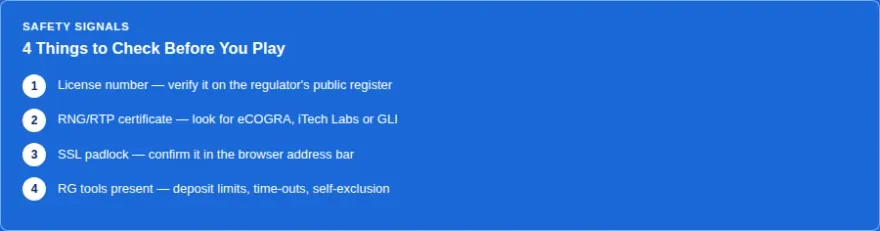
Safety on a slot site depends on four things working together. Who licensed the casino, whether the game itself is provably random, whether an independent lab has checked that, and whether your data and money are encrypted in transit all matter equally. Drop any one of those and "safe" becomes speculation without factual backing.
Licensing. A casino licensed by a body such as the UK Gambling Commission or the Malta Gaming Authority has gone through background checks on its owners, proof of funds to pay out winnings, and a requirement that games are independently certified before they go live. Licensed operators are also required to offer a dispute resolution path if a payout gets disputed, so you aren't left arguing into a void. Curaçao licensing has historically been looser and faster to obtain than UKGC or MGA, though the regime changed in December 2024. A new ordinance replaced the old master/sub-license system with direct licensing from a single regulator, the Curaçao Gaming Authority, and added requirements like a registered local office and a resident director. A license number sitting in a casino's footer is only a start. It's worth clicking through to the regulator's own register to confirm the number is real and current.
RNG and RTP. Every regulated slot runs on a Random Number Generator, a piece of audited software that decides each spin's outcome independently of the spin before it. There's no pattern to chase and no machine that's "due" for a win. Return to Player, or RTP, is the percentage of all money wagered on a game that the game is designed to pay back over a very large number of spins. It's a long-run average that may vary significantly in any single session or your next hundred spins. A slot with a strong published RTP can still run cold for an evening; that volatility is the nature of the game. What RTP and RNG certification tell you is that the odds are fixed and published, completely outside the casino's control.
Independent testing labs. eCOGRA was one of the first labs built specifically to audit online casino games and payout fairness, and its seal is still common across the industry. iTech Labs and GLI (Gaming Laboratories International) do similar work, testing RNGs and verifying that the RTP a game advertises matches what the software actually delivers. None of these labs certifies every casino in existence, and a missing seal doesn't automatically mean a site is dishonest. Plenty of newer or smaller-market operators run on other accredited testing houses. What matters is that some recognized lab's name and certificate are visible, verifiable, and publicly checkable.
Encryption. Any casino handling your card details or ID documents should run standard SSL/TLS encryption, visible as the padlock icon in your browser's address bar. This protects data in transit between your device and the casino's servers. Whether the casino will pay you fairly or honor its bonus terms requires separate verification through licensing and testing, independent of encryption.
Put together, these four signals are checkable in a way "it feels legit" never is. The table below is a quick reference for where to actually look.
| Signal | What it means | Where to check it |
|---|---|---|
| License number | Casino passed background and funding checks with a named regulator | Casino footer, cross-checked on the regulator's own public register |
| RNG/RTP certificate | Game outcomes are independently verified as random and the stated payback rate is accurate | Casino's "fairness" or "about" page, or the testing lab's own site |
| SSL padlock | Your personal and payment data is encrypted in transit | Browser address bar, next to the URL |
| RG tools | Casino provides deposit limits, time-outs and self-exclusion, which licensed regulators commonly require | Account settings or a dedicated "responsible gambling" page |
None of these four signals, alone, makes a casino bulletproof. Together, they separate an operator that's accountable to someone from one that answers to nobody.
Casino Software and RNG Providers
The game studio behind a slot matters almost as much as the casino hosting it, because the studio is where the RNG actually lives. A handful of names show up across most licensed casinos because they've been through repeated independent audits across multiple jurisdictions for years, and a problem with their RNG would cost them licenses across dozens of casinos simultaneously, affecting an entire ecosystem.
NetEnt is one of the oldest studios still operating, with decades of certified titles behind it. Games Global now runs the game catalogue and progressive jackpot network (including Mega Moolah) that used to carry the Microgaming name directly, after a 2022 acquisition. The games and their RNG certification remained unchanged; only the company holding them was replaced. Playtech and IGT supply both land-based machines and online slots, which means their RNGs answer to land-based gaming regulators as well as online ones. Pragmatic Play has become one of the most widely distributed studios of the last several years, with its games certified by multiple independent labs across the markets it operates in. WMS Gaming, a studio older players may still remember by name, now operates under Light & Wonder (formerly Scientific Games) following a series of corporate mergers. The games continued under new ownership; only the name on the certificate changed.
Being a large, publicly accountable company doesn't automatically make a studio's math generous. It does mean the company has a regulatory and reputational cost if it gets caught cutting corners on RNG certification, which creates real incentives toward fairness beyond mere claims about size.
How to Check If a Casino Is Safe Before You Play
Everything above is a set of facts about how the industry is supposed to work. Here's the shorter version you can actually run through before you create an account anywhere:
- Find the license number. It should be in the site's footer. Copy it and search the regulator's own public register to verify it yourself, since UKGC, MGA, and most other regulators publish searchable databases.
- Look for an RNG/RTP certificate or audit seal. eCOGRA, iTech Labs, and GLI are the names to look for. If a casino can't point you to one recognized lab, that's worth pausing on.
- Check for the SSL padlock. It takes two seconds and rules out the most basic kind of insecure site.
- Read independent reviews from external sources. Complaints about slow or refused payouts on third-party review sites are the clearest red flag a license number won't show you.
- Confirm responsible gambling tools are live and working, such as deposit limits, time-outs, and self-exclusion, reachable directly from your account settings.
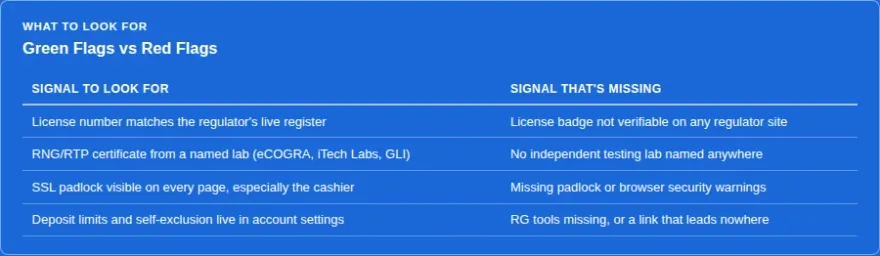
None of this takes long, and a casino that's genuinely licensed and audited will make every one of these things easy to find. One that buries or fakes them is telling you something.
Slots carry real financial risk even at a fully licensed, RNG-certified casino with a spotless audit history. Fairness means the odds are honest and calculated correctly, with profits never guaranteed over any time period. Set a deposit limit before you start, treat losses as entertainment costs with no expectation of recovery, and use self-exclusion tools if play ever stops feeling like a choice. Our responsible gambling page has practical tools and links to free support services if you want them. You must be 18+ (or the legal gambling age in your jurisdiction, whichever is higher) to play.
Conclusion
Regulated online slots run on a real, checkable framework: licensing bodies, independent testing labs, and audited software that turns the fairness question into something you can verify with evidence. That system only protects you if you actually check it. Verify the license number, confirm the RNG/RTP certificate is present, check that the SSL padlock is showing, and read outside reviews before you deposit. Skip those checks and you're relying on luck in more ways than one.