The Biggest Gambling Losses in History

The Biggest Gambling Losses in History
Casino tables always carry a risk, but with a little common sense, you shouldn't be too concerned about big losses. Gamblers who have lost everything have been unable to resist temptation. I don't think it matters if they were seeking a return on investment or acting out of ego.
Here are some examples of professional gamblers who have lost everything. While they are good anecdotes, they are rather poor examples of how to act and behave in a casino. All of their money and more were lost. Among today's gamblers are those who have lost substantial amounts of money gambling, or have gone from being wealthy to being poor.
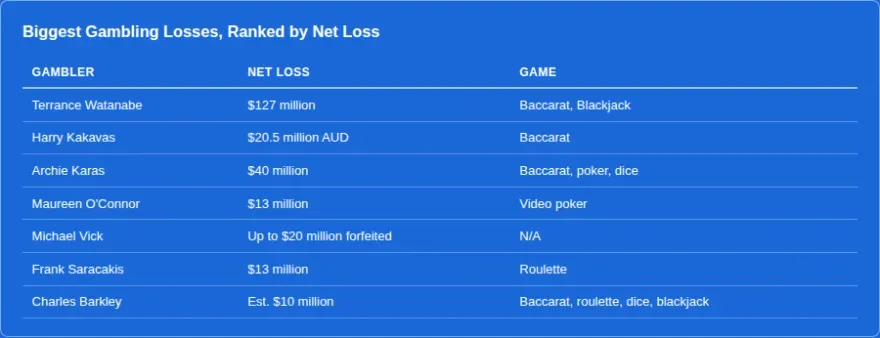
| Gambler | Total Wagered | Net Loss | Game |
|---|---|---|---|
| Terrance Watanabe | $825 million | $127 million | Baccarat, Blackjack |
| Harry Kakavas | $1.43 billion AUD | $20.5 million AUD | Baccarat |
| Maureen O'Connor | $1 billion | $13 million | Video poker |
| Archie Karas | $40 million | $40 million | Baccarat, poker, dice |
| Charles Barkley | Not disclosed | Est. $10 million | Baccarat, roulette, dice, blackjack |
| Michael Vick | N/A (dogfighting operation) | Up to $20 million forfeited | N/A |
| Frank Saracakis | $13 million | $13 million | Roulette |
Terrance Watanabe
Whenever we talk about the biggest gambling losers, there is usually some rivalry involved. Some people who have made a fortune, or have come into money by some other means, have felt inclined to gamble quite foolishly at one point or another. Terrance Watanabe, however, is one of those gamblers who lost it all, or at least a significant portion of his wealth.
Following the inheritance of an Oriental Trading Company in 1977, Watanabe sold it in 2000. He went on to play Blackjack and Baccarat at Caesar's Palace and The Rio. His 2007 losing streak became one of the largest ever recorded by a single player at those casinos.
Las Vegas has never seen a losing streak like Watanabe's, so far as world-renowned gamblers who have lost their entire fortunes are concerned. He later sued the casinos over the marketing and comps he received while gambling, alleging he was plied with alcohol and painkillers as his losses mounted. That suit drew a regulatory fine against Caesars from New Jersey gaming officials, even though the losses themselves happened in Nevada. Watanabe was also charged with felony counts of theft and passing bad checks over his unpaid casino debt. The case ended without a conviction or prison time. It was dropped as part of a confidential settlement with the casino.
Harry Kakavas
Despite not being the biggest loser, Harry Kakavas has made it a point to consistently lose. Even so, Kakavas has been able to minimize his losses through his prescience, skill, and knowledge so that he has certainly not suffered the biggest losses.
Kakavas gambled at Melbourne's Crown Casino for about sixteen months, between 2005 and 2006. Over that stretch he wagered a huge sum on baccarat and walked away with a significant net loss. Despite the scale of it, Kakavas kept coming back, and he never accepted that the casino was entitled to keep his money.
His lawsuit claimed Crown had exploited his "pathological interest" in gambling by continuing to court him as a high roller after it knew he had an addiction. It's a defense also raised by other famous gamblers who lost heavily. The case went all the way to the High Court of Australia in the matter known as Kakavas v Crown Melbourne Ltd. The court ruled against him. It found he had shown he could still make rational, self-interested decisions, including walking away from the tables when he chose to, so Crown had not unconscionably exploited a special disadvantage. He was not awarded any refund.
Maureen O'Connor
She developed a gambling problem after serving as mayor of San Diego. It could be argued that where power is, there is money, but in Maureen O'Connor's case, her gambling obsession became more sinister over time.
Still, O'Connor was quite successful in terms of mitigating risk compared to other unfortunate gamblers, a trait politicians have in common. She wagered enormous sums at video poker over roughly a decade, and her net losses were far smaller than the totals racked up by Kakavas or Watanabe.
Her late husband, Jack in the Box founder Robert O. Peterson, had left behind a charitable foundation. O'Connor took roughly $2 million from it to keep funding her habit, which led federal prosecutors to charge her with money laundering. She later reached a deferred-prosecution agreement, admitting to the conduct and agreeing to repay the money, after her lawyers cited a brain tumor as a contributing factor to her addiction.
The gambling addiction of O'Connor may be a little sensationalistic, but she deserves acknowledgment nonetheless for the success and merit she achieved earlier in her political and professional career.
Archie Karas
One of the most memorable gamblers who lost everything was Archie Karas. Archie enjoyed playing big with no qualms about taking on all kinds of risks for a shot at something better. Las Vegas was his first stop in December 1992, with only $50 in his pocket and a loan from a friend a little later. Over the next few years, in a run still remembered in gambling lore simply as "The Run," Archie built that stake into a fortune.
The wheels of fortune were set in motion when a destitute Archie spotted an old friend at The Mirage and asked for a $10,000 loan. Playing $200/400 limit Razz, he turned that into $30,000. He then returned $20,000 of it to his benefactor.
Lose
After winning $3 million at Binion's Horseshoe, Archie traveled around Las Vegas and amassed fortunes in every casino he encountered. His bankroll kept climbing, first past $5 million, then past $7 million, but he wasn't interested in searching for another opponent.
He would simply place a sum of cash on a table and wait for his opponent to approach. There was great interest, not least from players like Stu Ungar, who were popular but tragic figures. In two straight games, Archie defeated Stu, winning $500,000 in heads-up Razz and another $700,000 in 7-Card Stud.
Karas also beat other legends of the game, including Johnny Moss, Chip Reese, and Puggy Pearson, before his downfall began once he strayed from skill-based games into dice and baccarat. Why take on the risk of riskier games? We'll let him speak for himself.
"Something must be understood. I don't care about money. For me, it is not important. Material possessions are not important to me. All of it. You can't buy health, freedom, love, or happiness with money. Consequently, I don't fear money. I don't worry about losing it."
Casinos would allow Archie to wager way above the limit if he bargained effectively. He once won so many of Binion's highest-denomination chips that the casino ran out of them.

The gambler managed to lose the entire fortune in the span of a few weeks in 1995, quickly becoming one of the most unfortunate of all gamblers. Probably the most well-known gambler who lost it all is Archie.
Charles Barkley

It is no secret that NBA Hall of Famer Charles Barkley has struggled with a gambling problem over the years. In a widely cited ESPN interview, Barkley put a figure on what he'd lost gambling over his career. In later interviews he has floated higher numbers for his lifetime losses, so the exact total is disputed even by Barkley himself, but the original figure remains the most consistently cited one.
He claimed he lost millions of dollars playing at dozens of casinos during his active gambling years. It's interesting to hear his perspective on the subject. Barkley has accepted the good and the bad in his habits, whereas others have tried to sue casinos:
"I was in Vegas several times and won a million dollars. At least ten times. Nevertheless, I've also gone to Vegas and lost at least three times as much."
As a result, Barkley developed a mindset where he could accept a large loss in a single session. "I enjoy the action, I enjoy the justice," he explained. However, he added that everything should be done in moderation.
Charles Barkley is a fascinating individual. Definitely one of the biggest gamblers, but he lost a substantial share of his career earnings along the way. Even so, he has remained candid about it.
Michael Vick
Michael Vick's case doesn't fit the rest of this list. Vick was not convicted of gambling. He pleaded guilty to a federal charge over running Bad Newz Kennels, an interstate dogfighting operation that also involved gambling on the fights themselves. He shows up on "biggest gambling losses" lists anyway because of the size of the financial fallout, even though the underlying conviction is animal fighting, not a casino or sports-betting loss.
The NFL suspended Vick indefinitely once he entered his plea. The Atlanta Falcons then moved to recover a large share of his signing bonus, citing the conduct that led to his suspension.
After a long and tortuous trial, in which the jury felt he hadn't taken full responsibility after failing both a drug test and a polygraph, he was sentenced to 23 months in prison. Even though he's made mistakes in the past, Vick has since made amends and returned to the spotlight, including as an NFL broadcast analyst. His story remains a cautionary tale about how illegal gambling and betting operations can unravel a career, even if it doesn't fit neatly into a "lost it all at the tables" narrative.
Frank Saracakis
As heir to a large Greek Automobile Company, Frank Saracakis decided to indulge in his favorite pastime, gambling, while visiting London casinos in 1995. The glitz of the Melting Pot lured him to Crockford's Casino in London.
The game he chose was roulette, which he played for quite some time before losing every single chip he had. Although Saracakis didn't lose everything, he suffered one of the largest gambling losses in history. This account is widely repeated in gambling folklore. Independent verification beyond casino-industry retellings is limited.
Every story on this list started as entertainment before it turned into a spiral. Gambling should stay entertainment. Set a deposit limit, avoid chasing losses, and use self-exclusion tools if it stops feeling that way.